
Landscaping
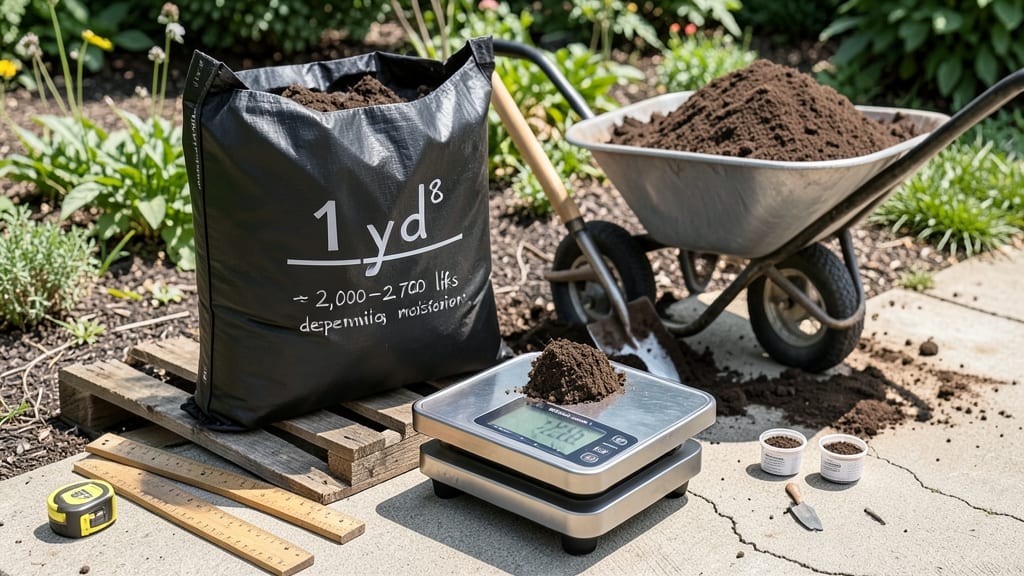
Determining the weight of 1 cubic yard of soil reveals a range of 2,000 to 2,800 pounds, influenced heavily by its composition and moisture levels.
Soil weight varies dramatically based on particle size and density. Clay particles pack tightly, creating heavier soil that can reach 3,000+ pounds per cubic yard, while sandy soils—with larger air pockets—typically weigh 1,800–2,200 pounds.
Moisture plays a critical role too: saturated soil can add 20–30% more weight due to water absorption in porous structures. For landscaping projects, this means your soil delivery costs and equipment needs will shift based on whether you're working with dry loam or damp clay. 🔥
Understanding these variations helps when calculating haulage fees or designing drainage systems. For example, clay-heavy soils may require heavier machinery for transport, while sandy soils might need additional moisture retention solutions. Always check moisture levels before estimating weight—what appears dry might surprise you once loaded.
💡 In This Article
- How Soil Composition Affects Weight per Cubic Yard
- Practical Weight Estimates for Common Garden Soils
How soil composition affects weight per cubic yard
Soil weight isn't just about volume—it's a direct result of particle density and how those particles pack together. Clay particles are flat and plate-like, measuring just 0.002 millimeters in diameter, allowing them to pack tightly with minimal air space.
This dense arrangement gives clay-heavy soils their characteristic weight, often exceeding 3,000 pounds per cubic yard when dry. In contrast, sandy soils consist of larger, rounded particles (0.05–2 millimeters) that create more air pockets, reducing density and weight to 1,800–2,200 pounds per cubic yard.
The magic number here is porosity—the percentage of air and water spaces between particles. Clay soils typically have 30–50% porosity, while sandy soils can reach 40–50% porosity but with larger voids.
Loam, the ideal garden soil mix, balances these extremes with 45–55% porosity and a weight range of 2,200–2,600 pounds per cubic yard. Organic matter further complicates this—composted materials add bulk but reduce overall density by up to 15% compared to mineral soils. 🌱
Moisture saturation creates the most dramatic weight shifts because water fills those porous spaces. Dry clay might weigh 2,800 pounds, but when fully saturated, it can jump to 3,500+ pounds—a 25% increase in mass.
This happens because clay particles attract water molecules through electrostatic forces, effectively "weighing down" the soil structure. Sandy soils show less dramatic changes (10–20% increase when wet) because their larger particles can't hold as much water.
Here's where things get technical: The specific gravity of soil minerals plays a role too. Quartz sand has a specific gravity of 2.65, while clay minerals like kaolinite measure 2.6–2.7. When combined with organic matter (specific gravity 1.3–1.5), the overall soil density decreases.
This is why potting mixes—often 50% organic matter—weigh significantly less (1,500–1,800 pounds per cubic yard) than native garden soils.
For practical applications, consider this: A 10-foot by 10-foot garden bed filled with clay soil to a depth of 6 inches contains about 0.35 cubic yards of material. At 3,000 pounds per cubic yard, that's 1,050 pounds of soil—enough to require heavy-duty wheelbarrows or mechanical assistance.
The same volume of sandy soil would weigh just 630 pounds, making it far easier to handle manually. 💪
What most people overlook is how compaction changes these numbers. When machinery or foot traffic compresses soil, porosity drops by 10–30%, increasing weight per cubic yard. This is why freshly tilled garden soil often feels lighter than undisturbed subsoil—it hasn't been compacted yet.
Understanding these compositional factors helps explain why your "light" topsoil delivery might suddenly feel heavier after a rainstorm.