
Light Requirements
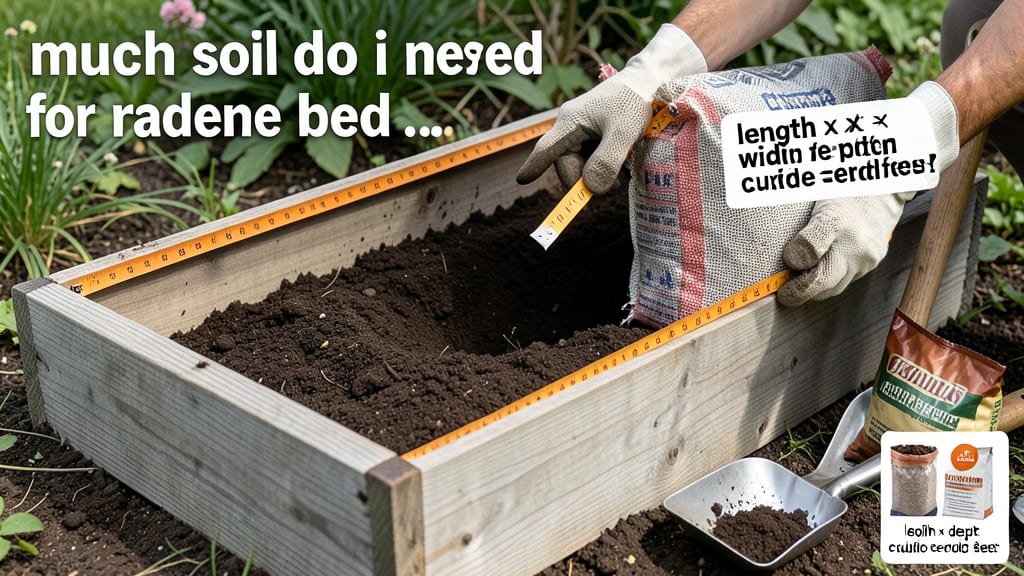
To calculate how much soil you need for a raised garden bed, multiply the bed’s length, width, and depth (in feet), then subtract any existing soil already in the bed. For example, a 4’x8’ bed filled 12” deep requires 32 cubic feet of soil.
Figuring out soil volume for a raised bed starts with simple math—length × width × depth—but don’t forget to account for any existing soil or drainage layers. 🌱 For instance, if your bed already has 4 inches of soil, you’ll need less topsoil than if you’re starting from scratch.
I always recommend buying 10-15% extra to account for settling and compaction, especially for heavy clay soils. Most garden centers sell soil in cubic yards, so convert your cubic feet by dividing by 27 (since 1 yard = 27 cubic feet).
Pro tip: Mixing 60% topsoil, 30% compost, and 10% perlite creates ideal drainage while retaining moisture. This blend also reduces the total volume needed compared to pure topsoil alone.
For a 4’x8’x12” bed, that’s roughly 24 cubic feet of topsoil and 8 cubic feet of compost—always round up to avoid running short mid-project.
💡 In This Article
- Calculating Soil Volume for Raised Garden Beds
- Best Soil Mixes and Quantity Adjustments for Raised Beds
Calculating soil volume for raised garden beds
The core calculation for soil volume involves multiplying your raised bed's dimensions in feet: length × width × depth. For example, a standard 4’x8’ bed filled 12” deep (or 1 foot) needs 32 cubic feet of soil.
Here's why this works: soil volume is measured in three dimensions, and converting inches to feet (12” = 1’) simplifies the math. If your bed has existing soil—say 4” deep—you’d subtract 13.33 cubic feet (4’x8’x0.333’), leaving 18.67 cubic feet needed for topsoil. 🌱
Most garden centers sell soil in cubic yards, so convert by dividing cubic feet by 27 (since 1 yard = 3’x3’x3’ = 27 cubic feet). For our 4’x8’x1’ bed, that’s 1.18 cubic yards (32 ÷ 27). Pro tip: Buy 10-15% extra—so 1.3 cubic yards—to account for settling.
Clay soils compact more, while sandy mixes may need less adjustment. Always measure your bed’s interior dimensions, not the frame’s outer edges, to avoid overestimating.
Drainage layers (like gravel or landscape fabric) also affect soil volume. A 2” gravel layer in a 4’x8’ bed adds 5.33 cubic feet (4’x8’x0.167’), which you’d subtract from your soil total. For compost mixes, reduce topsoil by the compost’s volume—say 30% of total soil—since compost takes up space.
A 4’x8’x12” bed with 30% compost would need 22.4 cubic feet of topsoil and 9.6 cubic feet of compost, totaling 32 cubic feet again. 💫
Real-world adjustments matter: soil bags list their volume when loose, but it compacts when spread. A 40-pound bag of topsoil typically holds 0.75 cubic feet, so you’d need 43 bags for 32 cubic feet. For large projects, rent a tractor or use a wheelbarrow to move soil efficiently.
Always test your soil’s drainage—if water pools after 30 minutes, add 10-20% perlite or vermiculite to improve aeration without changing the total volume significantly.
Consider soil type too: peat moss is lightweight (1 cubic foot = ~1 pound), while composted manure is heavier (1 cubic foot = ~20 pounds). Mixing these affects both volume and weight.
For a 4’x8’x12” bed, 60% topsoil (19.2 cubic feet) + 30% compost (9.6 cubic feet) + 10% perlite (3.2 cubic feet) gives you the ideal blend.
Weigh your materials if precision matters—topsoil averages 2,200 pounds per cubic yard, while compost is lighter at 1,000 pounds per cubic yard. ✨
Finally, account for future amendments. If you plan to add fertilizer or lime later, buy 5-10% less soil initially to avoid overflow. For a 4’x8’x12” bed, that’s 28-30 cubic feet of soil instead of 32.
Always store extra soil in a dry, covered area—moisture loss can reduce volume by 10-15% over weeks. 🌿