
Light Requirements
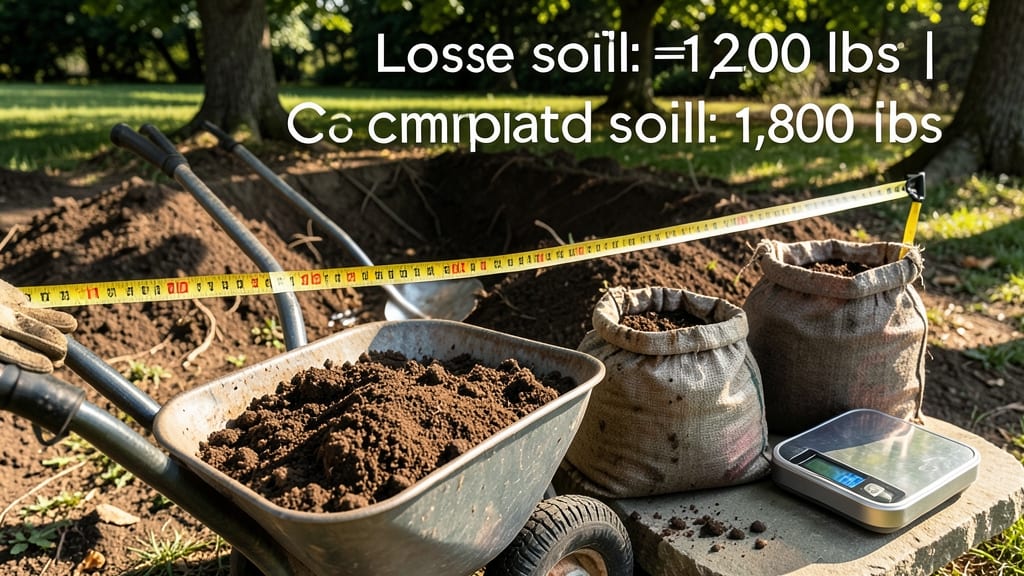
Determining how much a yard of soil weighs reveals a range of 2,000 to 2,700 pounds, with variations depending on moisture levels, organic material, and soil composition—clay-heavy soils can even surpass 3,000 pounds per cubic yard.
A yard of soil's weight isn't just about volume—it's a science of density and composition. 🌱 Clay soils pack in more mass due to their fine particles, while sandy soils feel lighter because of their loose structure.
Moisture plays a huge role too: a saturated yard of soil can weigh nearly twice as much as dry soil. For gardeners, this means checking soil moisture before ordering can save hundreds in delivery costs—especially when moving heavy loads like clay.
Understanding these factors helps with everything from landscaping projects to compost blending. For example, a 2,000-pound load of sandy soil is far easier to handle than 3,000 pounds of clay, which might require special equipment.
I always recommend testing a small batch first to estimate what you're working with—it makes planning (and budgeting) much smoother!
💡 In This Article
- What Determines the Weight of a Yard of Soil?
- Practical Tips for Estimating Soil Weight in Gardening Projects
What determines the weight of a yard of soil?
The weight of a cubic yard of soil isn't just about space—it's all about what's packed into that space. Soil weight depends primarily on its particle density, which varies dramatically by composition.
Clay soils, with their tiny, tightly packed particles, can reach 2,700 pounds or more per cubic yard when dry, while sandy soils—with larger, loosely arranged grains—often weigh closer to 1,500 pounds.
The difference comes down to how much solid material fits into the same volume: clay particles are 10-100 times smaller than sand grains, allowing more mass to accumulate.
Moisture content is the wild card that can swing weights by hundreds of pounds.
A saturated yard of clay soil might weigh 3,500 pounds or more due to water filling pore spaces between particles, while the same volume of dry clay could be under 2,000 pounds. 💧 The rule of thumb is that water adds about 62.4 pounds per cubic foot (the weight of water itself), so a single inch of moisture across a yard can add 200+ pounds.
This explains why spring delivery orders often surprise gardeners with unexpectedly heavy loads—recent rains can turn a "standard" soil order into a lifting challenge.
Organic matter plays a subtle but important role too. Compost-amended soils weigh slightly less than pure mineral soils because organic materials are less dense. A yard of 50% compost blend might weigh 1,800-2,200 pounds compared to 2,500+ pounds for the same volume of pure clay.
The trade-off? Organic soils improve drainage and plant growth, making the lighter weight a worthwhile compromise for many gardeners. What's fascinating is how this organic content also affects compaction—wet compost blends can become surprisingly heavy when trodden down.
Compaction is another critical factor that changes weight calculations. Loose, freshly delivered soil weighs less than when it's been compacted by equipment or foot traffic.
For example, a cubic yard of loose topsoil might weigh 2,200 pounds when delivered, but after spreading and tamping for a garden bed, it could settle to 2,500 pounds in the same volume.
This is why professional landscapers always specify "loose" or "compacted" when ordering—it affects both cost and project planning.
Here's a quick comparison of common soil types by weight:
- Sandy soil: 1,500-1,800 pounds (loose, dry)
- Loamy soil: 2,000-2,400 pounds (balanced texture)
- Clay soil: 2,500-3,000+ pounds (dense, dry)
- Saturated clay: 3,500+ pounds (water-filled pores)
- Compost blend: 1,800-2,200 pounds (lighter but nutrient-rich)
The takeaway? Soil weight is a dynamic measurement that changes with moisture, organic content, and compaction.
For accurate planning, always check with your supplier about current moisture levels and whether the soil is loose or compacted—it could mean the difference between a manageable project and one that requires heavy equipment! 🚜