
Light Requirements
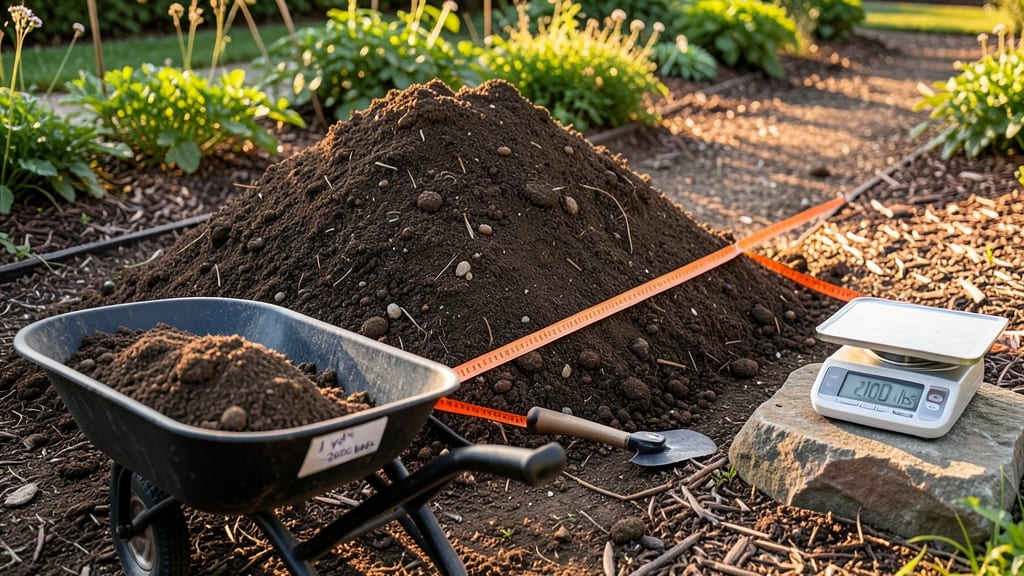
A yard of topsoil typically weighs 2,000 to 2,200 pounds, while clay soil can exceed 2,500 pounds, and sandy soil may weigh 1,500 to 1,800 pounds—factors like moisture and compaction further alter weight per cubic yard.
A yard of soil's weight isn't just about volume—it's all about what's inside. 🌱 Clay soil packs more weight because its tiny particles trap water and air, creating dense layers, while sandy soil stays lighter due to larger gaps between grains.
Even a small change in moisture can swing your soil's weight by hundreds of pounds, which is why I always check the weather before moving heavy loads.
For gardeners, knowing these differences helps you plan for delivery logistics, raised bed construction, or even compost mixing—heavy clay soil might need a wheelbarrow with reinforced sides, while loose sand could require extra trips to transport the same volume.
What's especially useful is understanding how these weights translate to real-world tasks. For example, a standard wheelbarrow holds about 2 cubic feet, so you'd need roughly 27 wheelbarrow loads to move a full yard of topsoil—each trip feeling significantly heavier with clay than with sand.
This knowledge saves time, prevents back strain, and helps you budget for delivery fees, which often charge by weight rather than volume.
💡 In This Article
- Soil Weight Variations by Type and Composition
- Practical Tips for Estimating Soil Weight in Gardening Projects
Soil weight variations by type and composition
Soil weight isn't just about volume—it's determined by particle size, moisture content, and how tightly those particles pack together. Clay soil weighs the most because its microscopic particles pack densely, trapping water and air in tiny spaces.
A cubic yard of wet clay can easily hit 2,500 pounds or more, while dry clay might still weigh around 2,000 pounds. This density comes from the particles' flat, plate-like structure that stacks like pages in a book, leaving minimal air gaps.
Sandy soil, on the other hand, feels light because its large grains create big air pockets between them. A yard of dry sand typically weighs 1,500 to 1,800 pounds, but when saturated with water, it can approach 2,000 pounds—the water fills those gaps, adding significant bulk.
Loam, the ideal gardening soil, falls in between with weights of 1,800 to 2,200 pounds per yard because it balances sand, silt, and clay particles while retaining organic matter that adds slight extra weight.
The moisture factor is critical—water alone can add 500 pounds or more to a yard of soil. For example, dry topsoil might weigh 1,800 pounds, but after a heavy rain, that same volume could swell to 2,300 pounds.
This is why soil delivery companies often specify "dry weight" in contracts, as unexpected moisture can make loads dangerously heavy. Even organic matter plays a role: compost-amended soil weighs slightly more than pure mineral soil due to decomposed plant material's higher water-holding capacity.
Compaction further alters weight—foot traffic or machinery can compress soil by 10-20%, reducing air space and increasing density. For instance, a freshly tilled garden bed might weigh 2,000 pounds per yard, but after years of walking, that same soil could reach 2,400 pounds.
This explains why clay soil feels heavier in established gardens versus newly dug areas. The science here involves particle arrangement: tighter packing means more mass in the same volume.
Here's how these variations play out in real gardening scenarios: Moving 27 wheelbarrow loads of clay soil (each holding 2 cubic feet) becomes a labor-intensive task compared to sandy soil, where the same volume might require 30 loads but each feels significantly lighter.
This weight difference affects everything from equipment selection to physical strain—clay soil's density can strain wheelbarrow frames or require reinforced dollies.
For precise calculations, gardeners often use the "bulk density" measurement, which combines particle density with porosity. Clay's bulk density typically ranges from 1.1 to 1.6 grams per cubic centimeter, while sand sits at 1.6 to 1.8 g/cm³ when dry.
The key takeaway? Always account for soil type and moisture when planning projects—what feels manageable with sand could become a back-breaking challenge with clay.