Neem Oil
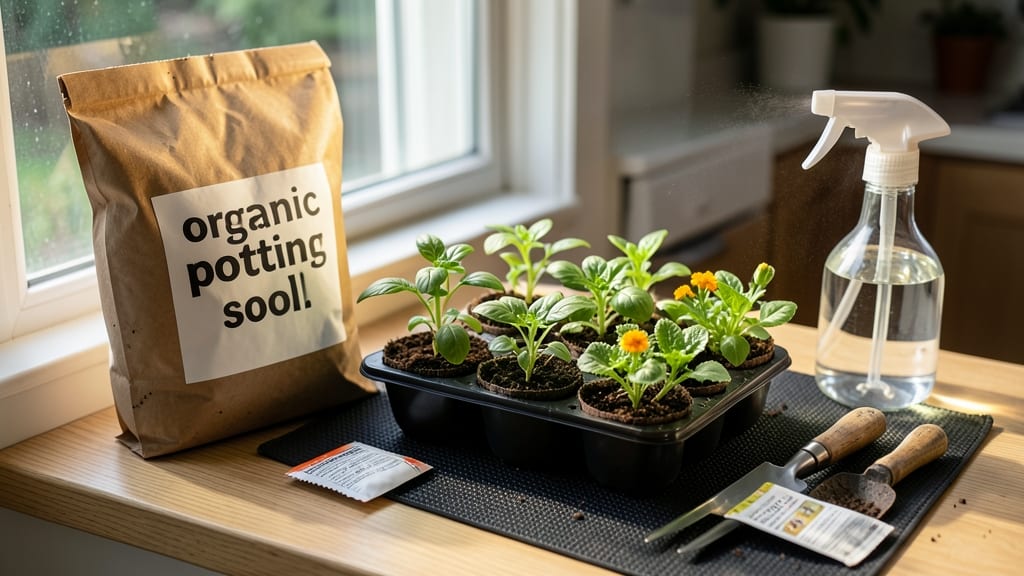
You shouldn't use potting soil to start seeds because it lacks the sterile, well-draining properties needed for germination, often leading to damping-off disease or poor root development. Opt for seed-starting mix instead for better results.
Potting soil is designed for established plants, not delicate seedlings.
The heavier texture and potential pathogens create an ideal environment for damping-off disease, where seedlings rot at the base. 🌱 Seed-starting mixes are specifically formulated with lightweight ingredients like peat moss or coconut coir to improve aeration and moisture control—critical factors for successful germination.
I’ve seen firsthand how a proper seed-starting mix can double your germination rates compared to potting soil.
For best results, choose a mix labeled "seed-starting" or create your own by combining equal parts peat moss, perlite, and vermiculite. This combination ensures proper drainage while retaining enough moisture to support young roots.
Once seedlings develop their first true leaves, you can transition them to potting soil for continued growth.
💡 In This Article
- Why Potting Soil Fails for Seed Germination
- Best Seed-Starting Soil Alternatives and Mixes
Why potting soil fails for seed germination
Potting soil is engineered for mature plants with established root systems, not delicate seeds. The key issue lies in its texture and density—potting mixes typically contain larger particles like bark or compost that create air pockets too big for tiny seedlings.
This means roots struggle to establish firm anchorage, leading to weak stems that topple over or fail to absorb nutrients efficiently. 🌱
Another critical factor is sterility. Potting soil often contains organic matter that hasn't fully decomposed, harboring fungal spores and bacteria that trigger damping-off disease. This fungal infection causes seedlings to rot at the soil line, often within days of germination.
Seed-starting mixes, by contrast, undergo pasteurization to eliminate 99% of pathogens while maintaining essential microbial activity for healthy root development.
The moisture retention balance is also off. Potting soil tends to stay too damp for extended periods, suffocating young roots that need oxygen. Seedlings require a 60-70% moisture level—just enough to keep the soil moist but not waterlogged.
Potting soil's heavier composition holds excess water, creating anaerobic conditions that stunt growth or invite mold. 💧
Nutrient levels play a role too. Potting soil is formulated with slow-release fertilizers designed for gradual plant growth, but seedlings need immediate, balanced nutrition to develop strong cotyledons. The nutrient profile in seed-starting mixes is lighter but more accessible, supporting the rapid cellular division required during germination.
Without this balance, seedlings often produce weak, yellowing leaves that can't photosynthesize effectively.
Consider this comparison: A seed-starting mix might have a porosity rating of 80-90% (meaning 80-90% air space), while potting soil typically sits at 50-60%. This air gap is crucial for oxygen diffusion to root zones—a difference that can mean the difference between thriving seedlings and a failed batch.
The lighter, fluffier composition of seed-starting mixes also allows for better seed-to-soil contact, ensuring consistent moisture without compacting around delicate embryonic roots.
Finally, the pH balance matters. Seed-starting mixes are typically 5.8-6.5**, creating an ideal environment for microbial activity that breaks down organic matter into plant-accessible nutrients.
Potting soil often skews higher (6.5-7.5), which can lock out essential micronutrients like iron and manganese that seedlings desperately need during their first growth stages. 🌱