Advice
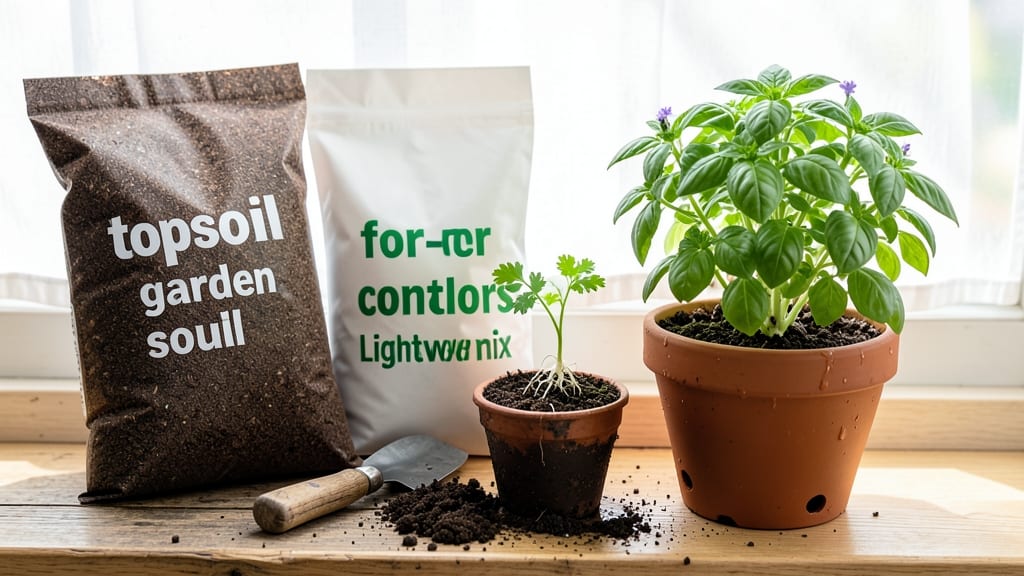
You shouldn't use garden soil for potting because it compacts easily, lacks proper drainage, and may contain pests or weeds. Instead, opt for lightweight potting mix with perlite or vermiculite to ensure healthy root growth and aeration.
Garden soil's heavy clay or silt content creates a dense medium that suffocates roots by blocking airflow and trapping excess moisture. 🌱 This leads to rot and stunted growth, especially in containers where drainage is critical.
Even if you sterilize it, garden soil often lacks the balanced nutrients and organic matter found in commercial potting mixes designed specifically for container gardening.
For best results, I recommend mixing 50% potting soil with 25% perlite and 25% compost to create a well-draining, nutrient-rich blend. This combination mimics the airy structure of natural forest soil while preventing compaction.
If you must use garden soil, amend it with sand or coconut coir and test moisture levels frequently to avoid waterlogging.
💡 In This Article
- Why Garden Soil Fails as Potting Mix
- Best Alternatives to Garden Soil for Potting
Why garden soil fails as potting mix
Garden soil is designed for in-ground planting where roots can spread freely, but containers create a completely different environment.
The dense clay or silt particles in garden soil pack tightly when watered, reducing pore space between particles to less than 10%—far below the 25-30% air space roots need to breathe. This compaction forces roots to compete for oxygen, leading to stunted growth or suffocation. 🌱
Poor aeration isn't the only issue—garden soil also struggles with moisture control. Unlike potting mixes formulated with perlite or vermiculite (which hold 3-5x their weight in water), garden soil can either dry out too quickly or stay soggy for days.
The lack of organic matter means nutrients leach out faster, requiring frequent fertilization. For example, a 1-gallon container planted with garden soil may need fertilizing every 2-3 weeks compared to every 6-8 weeks with a quality potting mix.
Pests and pathogens thrive in garden soil too. Weed seeds, fungal spores, and insect larvae hidden in garden soil can survive sterilization attempts and infect container plants.
Even if you sterilize soil by baking it (200°F for 30 minutes), you won't eliminate microscopic nematodes or bacterial buildup that potting mixes avoid through pasteurization processes. This is why professional mixes often include mycorrhizal fungi—beneficial microbes that boost root health without introducing harm.
Texture plays a critical role too. Garden soil's particles (sand, silt, clay) create a high bulk density (typically 1.2-1.6 g/cm³), while potting mixes achieve 0.5-0.8 g/cm³. This lighter structure prevents root rot by allowing excess water to drain quickly.
For instance, a 10-inch pot filled with garden soil might take 2+ hours to drain, while the same pot with potting mix drains in 10-15 minutes.
The nutrient imbalance is another silent killer. Garden soil often lacks the balanced NPK ratios (nitrogen, phosphorus, potassium) that potting mixes provide. For example, a 1-cubic-foot bag of garden soil might contain 0.5% nitrogen, while potting mixes average 1.5-2.5% nitrogen.
This forces plants to work harder to access nutrients, slowing growth and reducing yields by up to 40%.
Even if you sterilize and amend garden soil, it still can't replicate the microbial diversity of potting mixes. Commercial blends include beneficial bacteria that break down organic matter into plant-available nutrients, while garden soil lacks this ecosystem.
Think of it like comparing a homemade salad to a pre-mixed salad dressing***—one requires effort to balance, while the other is optimized from the start. 💫