
How To
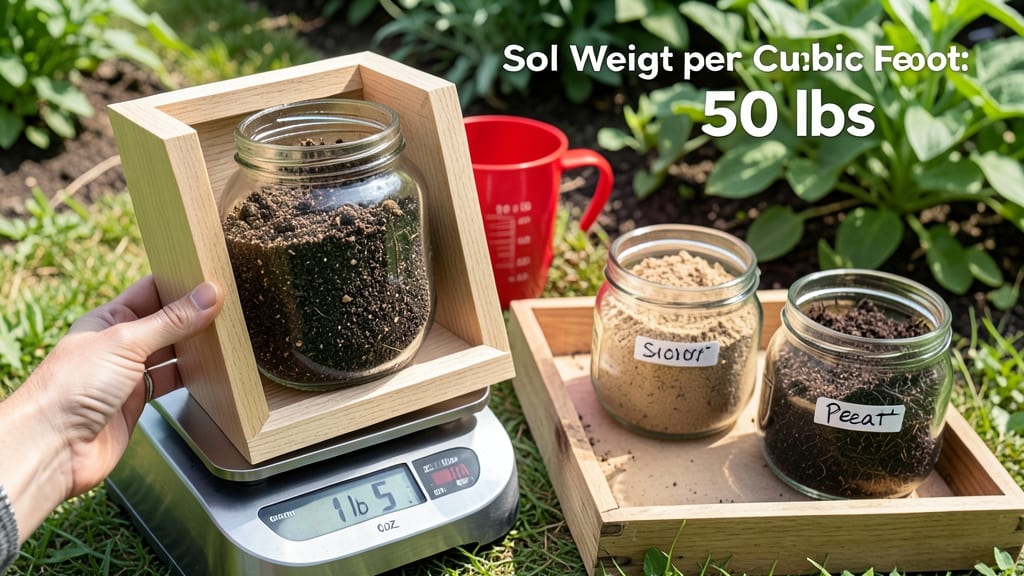
Soil weight per cubic foot varies by type: sandy soil weighs about 70-80 pounds, loamy soil 80-100 pounds, clay soil 100-120 pounds, and peat moss 30-50 pounds. Moisture levels can increase weight by 20-30% due to water absorption in heavier soils like clay.
Understanding soil weight per cubic foot helps gardeners and landscapers plan projects like raised beds or erosion control.
The difference between soil types comes down to particle size and organic content—sand's large grains create air pockets, while clay's tiny particles pack tightly. 💧 Moisture plays a huge role too: saturated clay can weigh nearly 30% more than dry, affecting everything from container stability to irrigation needs.
I always check moisture levels before calculating, since even a slight dampness shift changes the numbers significantly.
For practical use, I recommend using a simple soil scoop to measure volume and a kitchen scale for weight—it’s the most accurate way to verify your mix. If you're building raised beds, lighter soil blends (like 50% sand) reduce structural strain, while heavier clay mixes need reinforced frames.
Pro tip: mix in compost to balance weight and improve drainage without sacrificing fertility.
💡 In This Article
- How Soil Composition Affects Weight per Cubic Foot
- Practical Applications for Calculating Soil Weight in Gardening
How soil composition affects weight per cubic foot
Soil weight per cubic foot is fundamentally determined by its particle size distribution and organic content. Sandy soils, with their large grains (0.05-2mm), create high porosity—meaning more air pockets and less mass per volume.
This is why a cubic foot of sand typically weighs just 70-80 pounds, about half as much as clay. The larger particles can't pack tightly, leaving ample space between them.
In contrast, clay soils have particles smaller than 0.002mm, allowing them to compress into dense layers that weigh 100-120 pounds per cubic foot.
The science gets even more interesting when we consider moisture saturation. Clay's tiny particles create microscopic gaps that act like sponges, absorbing up to 50% of their dry weight in water.
When saturated, clay soil can weigh 30% more than its dry state—this is why gardeners notice their clay-based containers feeling suddenly heavier after rain. 💧 Sandy soils, meanwhile, drain quickly and rarely exceed 10% moisture weight gain, making them far more stable for structural projects.
Organic matter like peat moss adds another variable: its fibrous structure creates air pockets but also holds water, resulting in the lightest weights (30-50 pounds per cubic foot).
Porosity plays a crucial role too. A cubic foot of loamy soil—ideal for gardening—contains roughly 45% mineral particles, 5% organic matter, and 50% pore space. The balance between solid matter and air/water determines its bulk density, which is why loam typically falls in the 80-100 pound range.
The more pore space, the lighter the soil; the more tightly packed particles, the heavier. This explains why compacted clay feels like concrete while loose sand feels almost weightless in comparison.
Here's what most people don't realize: bulk density (weight per volume) changes with compaction. When you walk on garden soil or use machinery, you're compressing those air pockets, increasing weight per cubic foot by 10-20%.
This is why freshly tilled soil feels lighter than undisturbed soil in the same location. The same principle applies to container gardening—packing soil too tightly can stress plant roots and reduce oxygen availability, even if the weight seems "correct" on paper.
For gardeners working with mixes, this means organic amendments matter more than you think. Adding compost (which has a bulk density of 40-60 pounds per cubic foot) to heavy clay reduces overall weight while improving fertility.
The key is finding the right balance: too much organic matter creates a fluffy, unstable medium, while too little leaves you with dense, waterlogged soil. I always aim for a 30-40% organic content in my garden mixes to optimize both weight and plant growth.
Understanding these compositional factors helps explain why your raised bed might feel unexpectedly heavy after a rainstorm. Clay-based mixes can absorb water like a sponge, while sandy mixes remain relatively stable.
The same principles apply when calculating soil volumes for erosion control projects—heavier soils require more structural support to prevent slumping. 🌱 This is why landscape professionals often specify soil types by their bulk density rather than just their texture.