
Vegetables
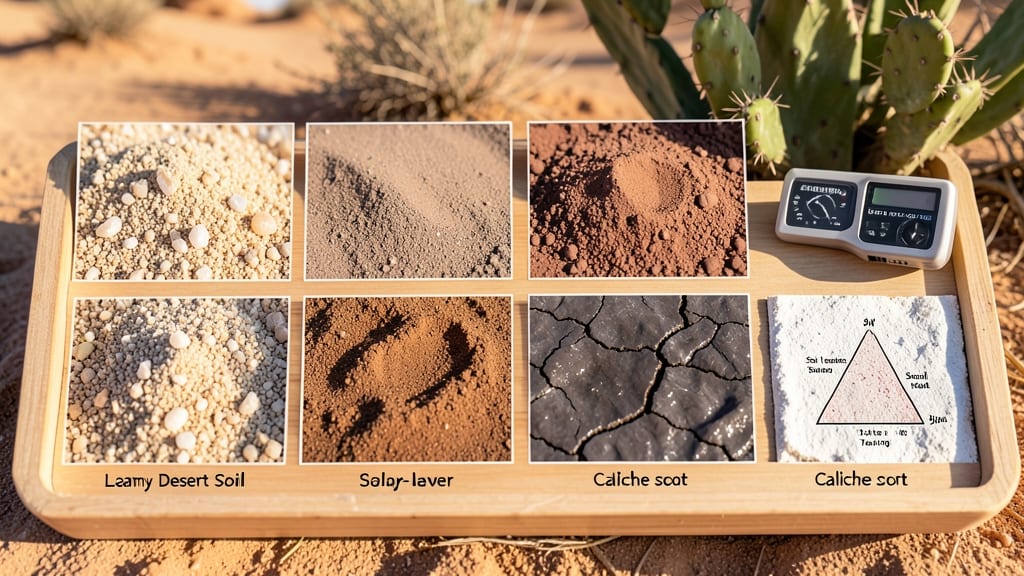
The types of soil in desert regions primarily include aridisols (the most common), entisols (young and undeveloped), and specialized varieties like salty or calcareous soils formed by intense evaporation and minimal organic buildup. These soils typically feature low nutrient levels and coarse textures due to harsh environmental conditions.
Desert soils develop under extreme conditions where water scarcity and high evaporation rates dominate. Aridisols, the most widespread type, form over centuries in dry climates, accumulating minerals like calcium carbonate that create hardpan layers.
Entisols, found in younger deserts, lack distinct horizons and often contain sand or gravel. 🌵 The scarcity of organic matter makes these soils challenging for traditional gardening, but their unique properties have shaped specialized plant adaptations like deep root systems and drought-resistant growth patterns.
Understanding these soil types helps explain why desert ecosystems thrive with minimal rainfall. The mineral-rich but nutrient-poor composition forces plants to evolve unique survival strategies, from storing water in fleshy stems to developing protective coatings against evaporation. This natural adaptation offers valuable lessons for sustainable agriculture in arid regions.
💡 In This Article
- How Desert Climate Creates Distinct Soil Types
- Gardening in Desert Soils: Adapting Plants to Unique Conditions
How desert climate creates distinct soil types
Desert soils develop through a combination of extreme aridity, intense solar radiation, and minimal organic input. The defining process is desertification, where evaporation rates often exceed precipitation by 10:1 or more—meaning for every inch of rain, ten inches of moisture evaporates.
This creates a cycle where water-soluble minerals like calcium carbonate and sodium accumulate near the surface, forming hardpan layers that block water infiltration. Aridisols, the dominant desert soil type, develop over centuries as these minerals precipitate out, creating a crusty, alkaline environment that resists decomposition.
The lack of organic matter—typically less than 1% by volume—stems from the absence of leaf litter and slow microbial activity in dry conditions. Compare this to forest soils, which can contain 5-10% organic matter from decomposing vegetation.
In deserts, what little organic material exists often comes from hardy shrubs like creosote bush, whose waxy leaves resist breakdown. The coarse texture, often 70-90% sand or gravel, further limits water retention, forcing plants to evolve specialized root systems like the 100-foot-deep taproots of the mesquite tree.
Temperature extremes play a critical role too. Daytime surface temperatures can reach 150-180°F in some deserts, while nights drop below freezing. This thermal shock accelerates mineral weathering, creating fine particles that get blown around by wind—a process called aeolian transport.
Over time, these particles form dunes or settle into layered deposits, contributing to the characteristic "moonscape" appearance of many desert soils. The result is a soil profile that's more about mineral accumulation than organic enrichment.
Salinity becomes a defining factor in some desert regions where groundwater seeps to the surface. Evaporation leaves behind concentrated salts, creating sodic soils that can have electrical conductivity levels 10 times higher than fertile soils. These conditions make agriculture nearly impossible without extensive amending.
Even where salinity isn't extreme, the combination of high pH (often 8.0-9.5) and low cation exchange capacity means nutrients like nitrogen and phosphorus bind tightly to minerals, making them unavailable to plants.
What makes desert soils truly unique is their dual nature**—they're both highly mineralized and biologically inactive. While they might contain abundant calcium carbonate or gypsum, these minerals don't translate to plant nutrition.
The contrast with tropical soils, which are nutrient-rich but prone to leaching, highlights how desert soils represent an entirely different ecological extreme. Understanding this mineral-organic imbalance is key to appreciating why desert ecosystems have evolved such specialized survival strategies.
Consider the Mojave Desert's aridisols: they contain 30-50% calcium carbonate within the top 2 feet, forming a cemented layer that can be as hard as concrete. This isn't just a surface phenomenon—it's a geological process that takes millennia to develop.
The same forces that create these soils also shape their challenges for human use, making them one of nature's most fascinating yet formidable environments. 🌵