
Tools
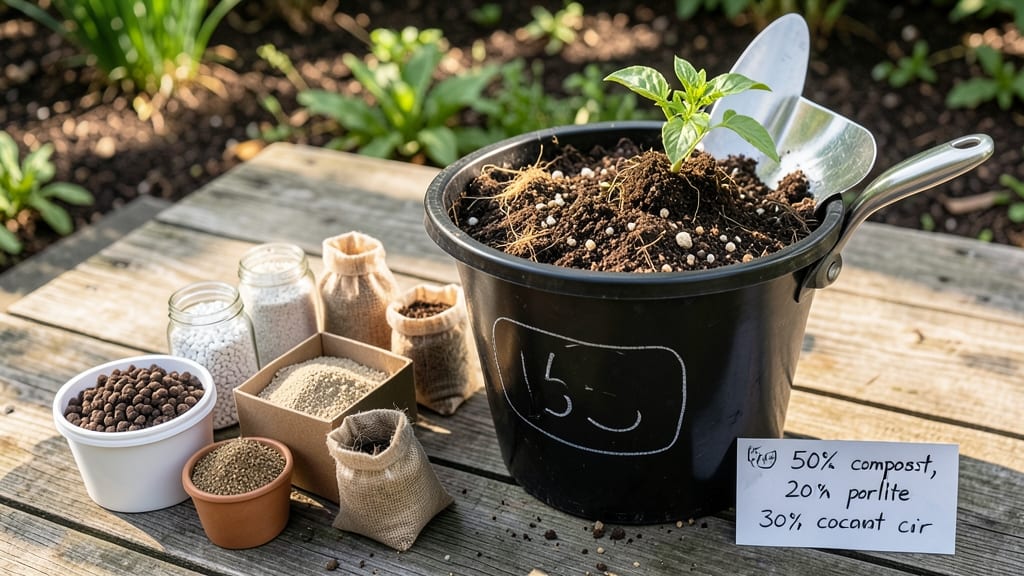
For a soil mixture in vegetable gardens, combine 60% topsoil, 20% compost, 10% perlite or coarse sand, and 10% aged manure to create an ideal balance of fertility, drainage, and aeration that supports strong root systems and nutrient uptake. Adjust these proportions based on whether your native soil is heavy clay or loose sand.
A well-balanced soil mixture acts like a three-layer cake for your plants' roots—each ingredient plays a critical role.
The compost and aged manure provide the organic matter that feeds microbes and retains moisture, while the perlite or sand creates air pockets to prevent suffocation. 🌱 This combination also improves water infiltration, which is especially important for heavy-feeding crops like tomatoes or peppers that need consistent nutrients without waterlogging.
Think of it as creating a sponge-like structure where roots can breathe and expand freely.
Your local soil type dictates where you start—clay soils need more sand and compost to break up compaction, while sandy soils benefit from extra organic matter to hold onto nutrients.
For example, leafy greens like spinach thrive in moisture-retentive blends, while root vegetables such as carrots prefer looser mixes to prevent forking. Testing your soil's pH and texture before mixing gives you a baseline to tweak ratios for optimal growth.
💡 In This Article
- How to Balance Soil Texture for Vegetable Root Growth
- Customizing Soil Mixes for Different Vegetable Types
How to balance soil texture for vegetable root growth
Soil texture is essentially the "skeleton" of your garden's foundation, where the ratios of sand, silt, and clay determine how water and air move through it. For vegetables, we aim for a loamy texture—about 40% sand, 40% silt, and 20% clay—which creates a crumbly, moisture-retentive structure.
This ideal balance allows roots to penetrate easily while preventing compaction that restricts growth. For instance, clay-heavy soils (common in many regions) can become waterlogged, while sandy soils drain too quickly, both of which stress plants.
The perlite or coarse sand in our mix specifically targets these extremes by improving aeration and drainage.
Organic matter like compost and aged manure acts as the "glue" that binds soil particles together without suffocating roots. When decomposed, these materials create humus, which holds 10-20 times its weight in water while still allowing oxygen to circulate.
This is why compost improves soil's porosity—the ability to hold both air and water—critical for preventing root rot in moisture-loving crops like tomatoes. Think of it like a well-aerated sponge: roots can breathe while accessing nutrients without drowning.
For example, a mix with 30% compost can increase soil's water-holding capacity by 30-50% compared to mineral soil alone.
Vegetables like carrots or radishes need this balance most critically because their roots grow downward and require loose soil to prevent deformities. The perlite or sand component (about 10% of the mix) creates macropores—large air pockets that prevent suffocation—while the aged manure provides slow-release nitrogen for steady growth.
Without this aeration, roots suffocate, leading to stunted plants or disease. For heavy feeders like corn, you might increase the manure to 15% to support rapid growth, while leafy greens can thrive with slightly more compost (25%) to retain moisture.
Here's what happens when the balance is off: Too much clay (30%+) creates a dense, brick-like structure that repels water, while too much sand (60%+) drains nutrients away like a sieve.
The key is testing your soil's texture by feel—a good loam should form a loose ribbon when moistened, not crumble (sandy) or stick (clay).
For troubleshooting, add 1-2 inches of compost to clay soils and 1 inch of perlite to sandy soils per square foot to adjust the ratios gradually. This method mimics nature's own soil-building process, where decomposed organic matter gradually improves structure over time.
Consider the porosity targets for different crops: Leafy greens (like spinach) need 50-60% porosity to retain moisture, while root vegetables (like beets) thrive in 40-50% porosity for better drainage.
The perlite in your mix contributes about 20-30% of the total porosity, while compost adds 10-20% more through its fibrous structure. This combination ensures roots have access to both oxygen and water simultaneously, which is especially critical during hot weather when evaporation rates spike.
For a visual reference, imagine holding a handful of your soil mixture: It should feel like a damp, crumbly cookie dough—not sticky (clay) or gritty (sand). This texture ensures that when you water, the moisture penetrates evenly rather than pooling or running off.
The aged manure also introduces beneficial microbes that break down organic matter, releasing nutrients in a form plants can absorb immediately. Without these microbes, even the best soil mix would lack the "living" component that turns raw materials into plant food. 🌱