
Light Requirements
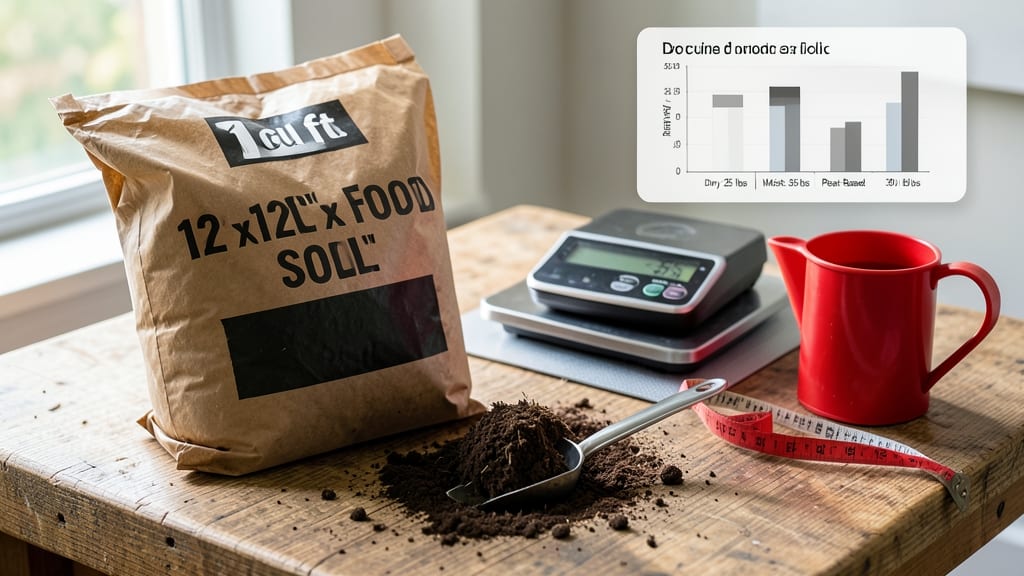
When measuring how much 1 cubic foot of potting soil weighs, expect 20 to 30 pounds in dry conditions, but this jumps to 30 to 45 pounds once fully saturated. Organic blends show greater weight variation due to their moisture-holding capacity and compost content.
Understanding potting soil weight matters because it directly impacts your garden setup. 🌱 For example, a 5-gallon container holds roughly 0.75 cubic feet of soil—so dry, that's about 15-22 pounds, while wet it could double.
This weight difference explains why raised beds need sturdy frames and why heavy bags of potting mix require proper lifting techniques. Organic soils, packed with peat moss or coconut coir, absorb more water, which is why they feel heavier even when damp compared to mineral-based mixes.
Here's a pro tip: if you're filling large containers, calculate the total soil volume first. Multiply the length × width × height (in feet) to get cubic footage, then use the weight ranges above.
For a 4'×8' raised bed (32 cubic feet), you're looking at 640 to 1,440 pounds when saturated—this is why many gardeners opt for lighter extended-release fertilizers to avoid overloading the soil structure.
💡 In This Article
- Factors Affecting Potting Soil Weight per Cubic Foot
- Potting Soil Weight Comparison for Containers and Raised Beds
Factors affecting potting soil weight per cubic foot
The weight of potting soil isn't just about volume—it's a science of ingredients and physics. Organic components like peat moss, coconut coir, and compost absorb water like a sponge, increasing weight dramatically when wet.
For example, peat moss alone can hold 4 to 6 times its dry weight in water, while perlite or vermiculite (inorganic amendments) add bulk without significant weight gain.
This explains why a 1 cubic foot bag of organic mix might feel 20 pounds dry but swell to 35 pounds when saturated, while a mineral-heavy blend stays closer to its dry weight.
Particle density plays a crucial role too. Fine organic matter compresses differently than coarse materials—think of the difference between flour (light and fluffy) and sand (dense and heavy).
A mix with 50% compost by volume can weigh 15-20% more than one with 10% compost, even when both appear similarly loose.
Compaction matters too: gently fluffed soil weighs less than packed-down soil in the same space, which is why gardeners often "lighten" mixes with perlite or rice hulls to reduce weight while improving aeration.
Moisture content is the wild card here. A 10% increase in moisture can add 2-3 pounds to that cubic foot, turning a manageable 25-pound bag into a cumbersome 28 pounds.
This is why professional growers track soil moisture with tensiometers—knowing when your mix is at 50% saturation (ideal for most plants) helps predict weight and avoid overwatering.
For example, a 10-gallon container (about 0.35 cubic feet) might hold 7-10 pounds dry but 12-15 pounds wet—a difference that affects how you handle it.
Let's break down the key components by weight contribution:
- Organic matter (peat, compost, bark): Adds 10-20 pounds per cubic foot when dry, but can absorb 5-10 pounds of water when saturated
- Inorganic amendments (perlite, vermiculite, sand): Contribute 5-10 pounds per cubic foot with minimal moisture absorption
- Fertilizers: Typically 1-3 pounds per cubic foot, but slow-release types add negligible weight
- Water: Can add 10-15 pounds to the cubic foot when fully saturated
The science behind this involves bulk density—how tightly packed the particles are. Organic soils often have lower bulk density when dry (more air pockets) but higher density when wet (water fills those gaps).
This is why a 1 cubic foot bag of coconut coir might weigh 18 pounds dry but 32 pounds wet, while a sand-heavy mix stays near 22 pounds regardless of moisture.
Understanding this helps you choose the right mix for your needs—lighter blends for hanging planters, heavier blends for stability in raised beds.
Here's a real-world example: a 4'×8' raised bed (32 cubic feet) filled with organic soil could weigh anywhere from 640 to 1,440 pounds depending on moisture. That's why many gardeners reinforce bed frames with 2×6 lumber instead of 1×6—the extra weight demands structural support.
For containers, this means opting for fabric grow bags (which distribute weight better) over rigid plastic pots when using heavy mixes.