
Light Requirements
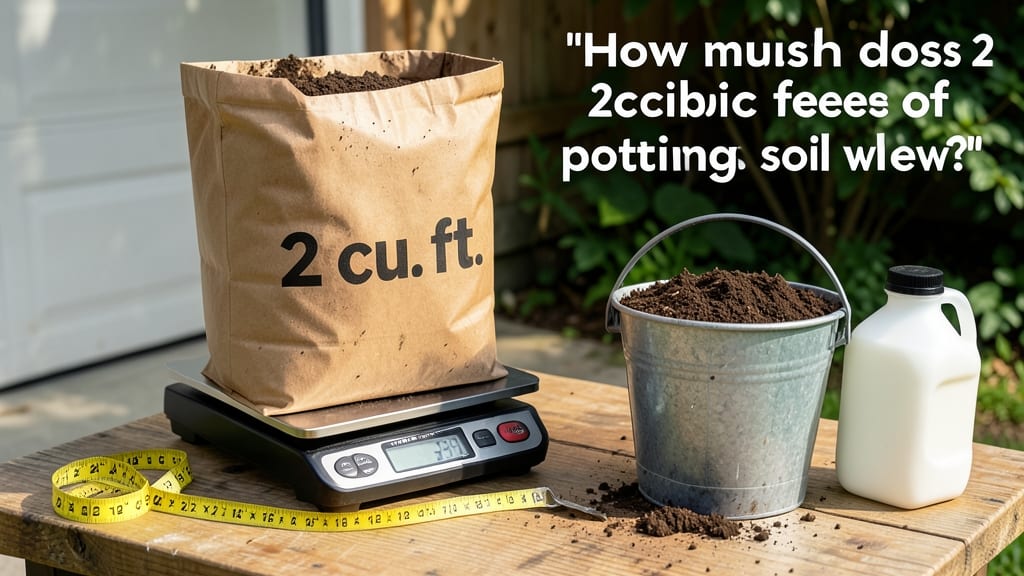
Two cubic feet of potting soil typically weighs 30 to 50 pounds, depending on the mix type—lightweight blends like peat-based soil average 30-35 lbs, while heavier mineral or compost-heavy mixes reach 40-50 lbs. Moisture levels also impact weight, with dry soil weighing less than damp or saturated soil.
Understanding how much your potting soil weighs helps you plan for lifting, transporting, or storing bags. 🌱 The weight difference comes down to what's in the mix—peat moss and coconut coir create lighter blends, while compost and sand make it heavier.
For example, a standard 2-cubic-foot bag of Miracle-Gro potting mix weighs around 35 pounds, but organic blends with added compost can tip the scales closer to 45 pounds.
Moisture plays a surprising role too. A dry bag might weigh 30 pounds, but once watered, it could swell to 40 pounds. This matters if you're calculating how many bags to carry or how much weight your containers can handle.
Always check the label for exact specs, as some brands vary significantly.
💡 In This Article
- Potting Soil Weight Variations by Composition
- Calculating Soil Weight for Garden Projects
Potting soil weight variations by composition
The weight of potting soil isn't just about volume—it's a science of ingredients.
Peat moss, the lightweight star of many mixes, has a density of about 0.25 pounds per cubic foot when dry, while compost can weigh 40-50 pounds per cubic foot due to its dense organic matter. 🌱 This explains why a 2-cubic-foot bag of peat-heavy mix might weigh just 30 pounds, but the same volume with added compost could hit 45 pounds.
Here's how key components stack up: perlite and vermiculite add airiness (reducing weight), while sand and minerals increase bulk. Cactus/succulent mixes often weigh 25-30 pounds for 2 cubic feet because they include gritty, lightweight volcanic rock.
Organic blends with worm castings or coconut coir typically land in the 35-40 pound range due to their moisture-retaining properties.
Moisture transforms weight dramatically. A dry bag might register 30 pounds, but after watering, it could swell to 38 pounds—that's nearly 27% more weight just from hydration. This is why professional gardeners always check soil moisture before calculating loads for raised beds or container gardens.
Texture plays a hidden role too. Finer particles (like silt) pack more densely than coarse sand, creating heavier mixes. For example, a 2-cubic-foot bag of sand-only soil would weigh 80-100 pounds, but when blended with organic matter, the weight drops significantly.
This is why most potting mixes strike a balance between aeration and density.
Consider this comparison: A 2-cubic-foot bag of sterile potting mix (mostly peat) weighs 32 pounds, while a similar volume of garden soil (with clay and organic debris) could weigh 50 pounds or more.
The difference comes down to particle size, organic content, and how tightly the ingredients are packed.
For gardeners planning large projects, understanding these variations helps avoid surprises. A 4x8-foot raised bed (containing 3.33 cubic feet) filled with lightweight mix might weigh 100 pounds total, but with heavier soil, that jumps to 150 pounds—a critical difference when moving or stabilizing the structure.