
Light Requirements
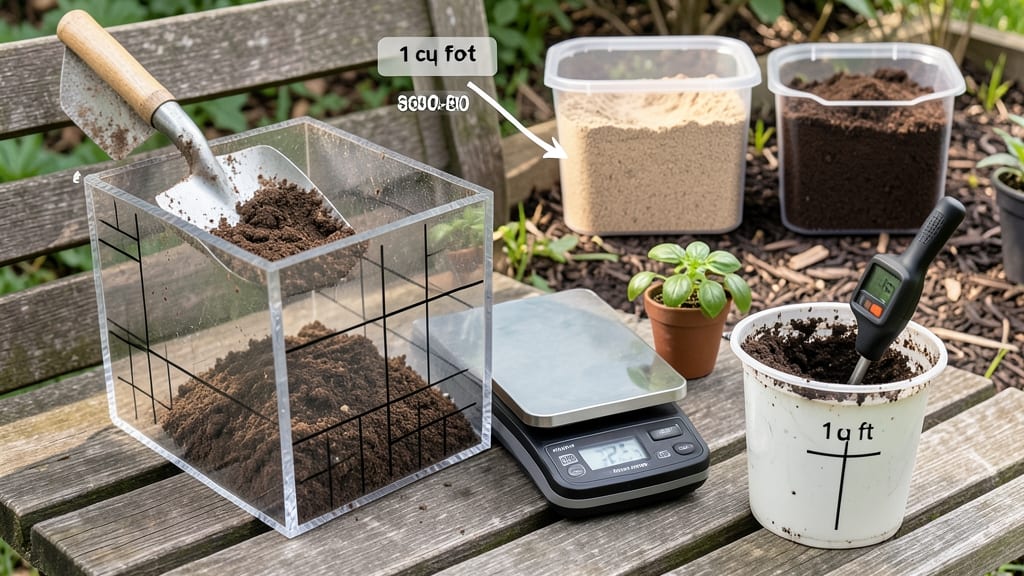
To determine how much 1 cubic foot of soil weighs, expect between 40 to 120 pounds depending on its composition—sandy soil typically weighs 40–60 lbs, while dense clay or saturated soil can reach up to 120 lbs. Water content and organic material play major roles in this variation.
Understanding soil weight isn't just about the numbers—it's about how those factors interact in your garden. 🌱 Sandy soils stay light because their large particles create air pockets, while clay soils pack tightly, increasing density.
Even a small change in moisture can swing the weight dramatically: dry soil might weigh 60 lbs, but after rain, that same cubic foot could hit 100 lbs. For gardeners, this matters when calculating raised bed stability or container capacity, where heavy clay soil might require structural reinforcement.
Most gardeners don't carry scales everywhere, but you can estimate by feeling soil moisture—damp soil always weighs more. I keep a moisture meter handy to check before heavy planting seasons, as even a 20% moisture increase can add 20+ pounds to that cubic foot.
This knowledge helps prevent overloading containers or compromising drainage systems.
💡 In This Article
- Soil Weight Variations by Composition and Density
- Practical Soil Weight Considerations for Gardeners
Soil weight variations by composition and density
The weight of a cubic foot of soil depends entirely on its composition, which determines how tightly the particles pack together. Sandy soil, with its large, loosely arranged grains, typically weighs 40–60 pounds per cubic foot because air fills the gaps between particles.
In contrast, clay soil has tiny, tightly packed particles that trap water and organic matter, giving it a weight range of 90–120 pounds—nearly double that of sand.
This difference happens because clay particles have a surface area 100 times greater than sand, allowing them to hold more moisture and organic debris.
Moisture is the wild card in soil weight calculations. Dry, well-drained sandy soil might weigh 50 pounds, but after a heavy rain, that same volume could swell to 75 pounds as water fills the pores.
For clay soil, the shift is even more dramatic—adding 20% moisture can increase weight by 30 pounds or more. The science behind this is simple: water has a density of 62.4 pounds per cubic foot, so every pore filled with water adds to the total weight.
Organic matter compounds this effect, as decomposed plant material adds 10–20 pounds per cubic foot compared to mineral-only soil.
Density calculations get technical when you consider porosity—the percentage of air and water spaces in soil. Sandy soil has a porosity of 30–40%, while clay can reach 50%+ when saturated. This means clay soil's weight fluctuates more with weather changes.
For example, a 12-inch-deep raised bed filled with clay soil might weigh 1,200 pounds dry but 1,500+ pounds after irrigation. Understanding these variations helps explain why clay-heavy gardens feel heavier underfoot and why sand-based soils are easier to move.
Real-world examples highlight these differences dramatically. A 5-gallon bucket (about 0.17 cubic feet) of dry sand weighs roughly 7 pounds, while the same volume of wet clay could hit 15 pounds.
This 100% weight difference in a small container shows why gardeners must account for soil type when designing structures. For instance, a 4'x8' raised bed filled with clay soil could weigh 1,600 pounds—enough to strain weak frames if not properly supported.
The key takeaway is that soil isn't just "dirt"; it's a dynamic material whose weight shifts with its moisture and composition.
To visualize these variations, imagine holding two 1-gallon containers—one filled with dry sand, the other with saturated clay. The sand feels light and gritty, while the clay feels dense and cool to the touch, almost like wet cement.
This tactile difference directly translates to weight: the clay container might weigh 12 pounds versus the sand's 6 pounds. The lesson here is that soil weight isn't static—it's a living measurement that changes with the seasons and your watering habits. 💧
For those curious about the math, soil density is calculated using the formula: Density = Mass / Volume. In practical terms, this means weighing a known volume (like a 1-liter container) and dividing by its volume.
A liter of dry sand might yield 1.6 kg (3.5 lbs), while the same volume of wet clay could reach 2.2 kg (4.9 lbs). This simple experiment reveals why gardeners often underestimate soil weight—especially when working with clay-heavy or organic-rich soils.