
How To
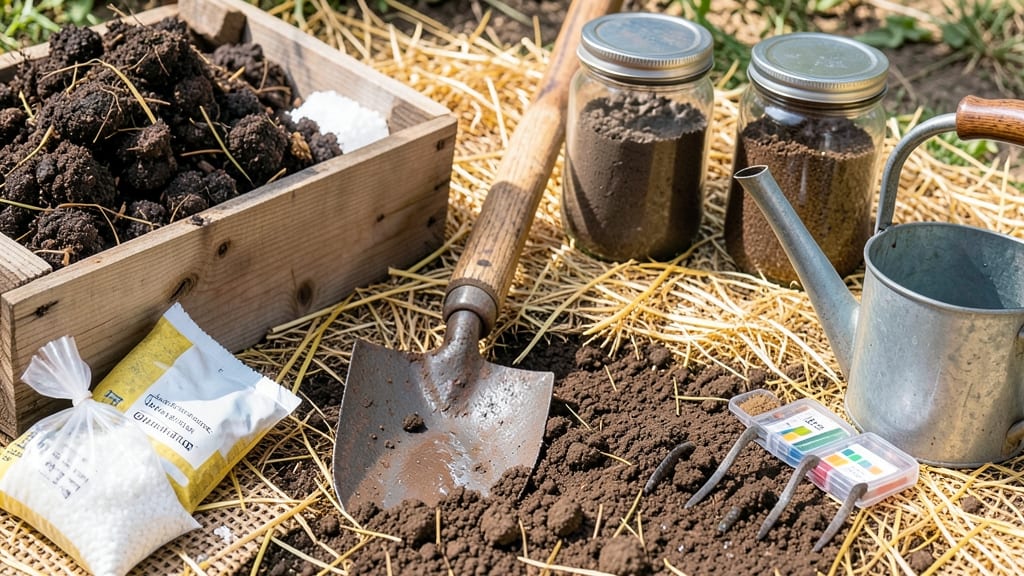
To fix clay soil for gardening, start by loosening compaction with a broadfork, then improve drainage by mixing in organic matter like compost or aged manure. Add coarse sand or perlite for better aeration, and till lightly to distribute amendments without harming roots.
Clay soil's heavy, dense nature makes it difficult for roots to breathe and water to drain properly, which is why adding organic materials like compost or peat moss is essential.
These amendments break up the compacted structure, allowing air and moisture to penetrate more easily. 🌱 For best results, I recommend testing your soil's pH first—most vegetables thrive in slightly acidic to neutral soil (6.0-7.0)—and then applying a 2-3 inch layer of compost before tilling.
The key is patience; clay soil improves gradually, so repeat the process annually if needed.
Another critical step is choosing the right tools. A broadfork is gentler than a rototiller and helps preserve soil structure, while a simple garden fork can aerate stubborn patches. If your garden bed feels rock-hard when pressed, focus on those areas first—they'll need extra attention to loosen up.
For sandy amendments, perlite works better than regular sand because it won't compact over time.
💡 In This Article
- Why Clay Soil Struggles and How Organic Amendments Help
- Step-by-Step Guide to Amending Clay Soil for Better Plant Growth
Why clay soil struggles and how organic amendments help
Clay soil's struggles stem from its microscopic structure—tiny plate-like particles pack tightly together, creating a dense matrix that restricts root growth and water movement. When water hits compacted clay, it pools on the surface instead of absorbing, while air gets trapped in microscopic pockets, suffocating plant roots.
This is why clay gardens often feel waterlogged after rain or dry out too quickly in summer. The solution lies in organic amendments that physically break up these dense layers while introducing beneficial microbes and fungi.
Compost works wonders because its fibrous texture creates air pockets when mixed in, improving oxygen flow to roots by up to 40% compared to unamended clay. The organic matter also feeds soil microbes, which break down clay particles over time, creating larger aggregates that hold moisture better.
For example, adding 2-3 inches of compost per square foot can transform heavy clay into a loamy texture within 6-12 months, though results vary with your climate and soil type. 🌱
Sand and perlite serve different purposes—while coarse sand (1/8 inch diameter) improves immediate drainage, perlite adds long-term aeration without compacting. The key difference is particle size: sand fills gaps between clay particles, while perlite's porous structure holds air and water separately.
I've found that mixing 1 part perlite to 3 parts compost gives the best balance for most vegetable gardens, preventing both waterlogging and drought stress.
Synthetic amendments like lime or gypsum offer quick fixes but lack the long-term benefits of organic matter. While gypsum can help break up clay temporarily, it doesn't improve soil biology or water retention like compost does.
The real magic happens when organic materials decompose, creating a sponge-like structure that holds 3-5 times more water than compacted clay while preventing nutrient runoff. This is why professional gardeners often recommend a 50-50 mix of compost and sand for clay-heavy soils.
One common mistake is over-tilling clay soil, which can actually make compaction worse by breaking clay particles into finer, more dense fragments. The solution? Use a broadfork to gently loosen the top 6-8 inches without disturbing the deeper layers.
This mimics natural soil aeration while preserving the beneficial microbial communities that thrive in slightly undisturbed clay. For stubborn patches, I recommend working in amendments during the fall or early spring when soil is moist but not waterlogged.
Think of clay soil like a tightly packed sponge—it needs the right materials to create space for air, water, and roots. Organic amendments act as spacers, while microbial activity gradually transforms the structure from dense to porous.
The result? Plants that thrive in soil that was once a gardener's nightmare. 💫