Lawn
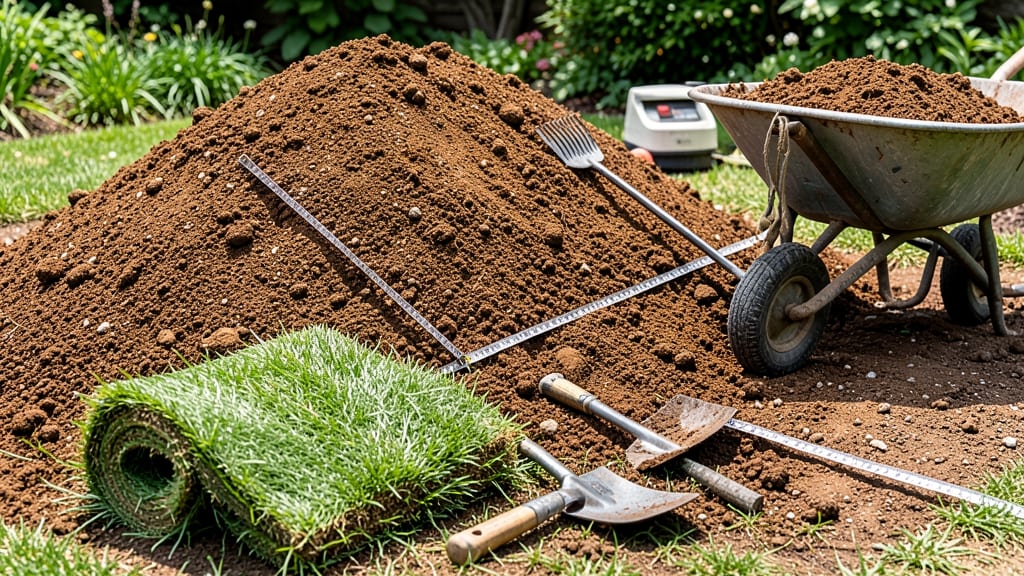
To determine how much topsoil you need for sod, spread a 2- to 4-inch layer evenly across the area to support root growth and proper drainage. Calculate the total by multiplying your lawn's square footage by the depth (in inches), then divide by 216 to convert to cubic yards.
This depth range isn't random—it strikes the perfect balance between giving roots enough room to establish without creating drainage issues. 2 inches works for small patches or areas with good existing soil, while 4 inches is ideal for larger installations or poor-quality subsoil. 216 is your magic number because it converts cubic feet to cubic yards (27 cubic feet = 1 cubic yard), making calculations straightforward.
I always add an extra 10% to my total to account for uneven ground or compaction during installation.
For example, a 500-square-foot lawn needing 3 inches of topsoil would require 1.16 cubic yards (500 × 3 ÷ 216). Round up to 1.25 cubic yards to ensure you have enough material. This method works for both small backyard patches and full lawn renovations, giving you precise measurements every time.
💡 In This Article
- Why Topsoil Depth Matters for Sod Success
- Calculating Topsoil for Sod by Project Size
Why topsoil depth matters for sod success
The ideal 2- to 4-inch topsoil layer for sod isn't arbitrary—it's rooted in how grass roots behave. Sod roots need 1-2 inches of loose soil to establish within the first 2 weeks, while deeper roots (up to 6 inches) develop over 3-6 months.
Shallow layers (1 inch) risk smothering roots, while depths beyond 4 inches create drainage issues and waste material. 🌱
Moisture retention is another critical factor. A 3-inch layer holds 30-40% more water than 2 inches while still allowing excess to drain, preventing root rot. The topsoil's organic matter (typically 5-10% compost) also breaks down at this depth, releasing nutrients over time.
Clay-heavy soils benefit most from the 4-inch maximum, while sandy soils can safely use 2-3 inches without drainage problems.
Compaction plays a hidden role too. When you walk on freshly laid sod, you're compressing the topsoil layer by 10-15%. This is why professional installers often recommend 4 inches for high-traffic areas—the extra depth accommodates this natural settling.
The topsoil's particle density (how tightly packed the soil is) affects how easily roots can push through; looser topsoil (achieved by aeration) improves root penetration by 30-50%.
Nutrient distribution follows a depth gradient: The top 1 inch contains 60% of available nitrogen, while phosphorus and potassium concentrate in the 2-3 inch zone. This vertical nutrient profile mirrors how grass roots grow—shallow at first, then deeper.
For example, Kentucky bluegrass roots reach 6 inches in 60 days with proper topsoil depth, while shallow planting limits them to 2-3 inches, stunting growth.
One common mistake is assuming all topsoil is equal. Screened topsoil (with particles 1/4 inch or smaller) compacts more than bulk topsoil, requiring 10-15% more volume to achieve the same depth. For slopes over 10% grade, increase depth by 25% to prevent erosion and maintain even moisture distribution.
This is why landscape professionals often specify 4 inches for hillsides—it accounts for both root needs and gravitational forces.
Think of topsoil depth like a root highway system: Too shallow, and roots congest at the surface; too deep, and they struggle to reach nutrients. The 2-4 inch range creates the perfect balance where roots can explore vertically while still accessing surface moisture.
This zone also aligns with how sod rolls are typically 3/4 to 1 inch thick—the topsoil layer needs to be 2-3 times deeper than the sod itself for optimal integration. 🌿