
Light Requirements
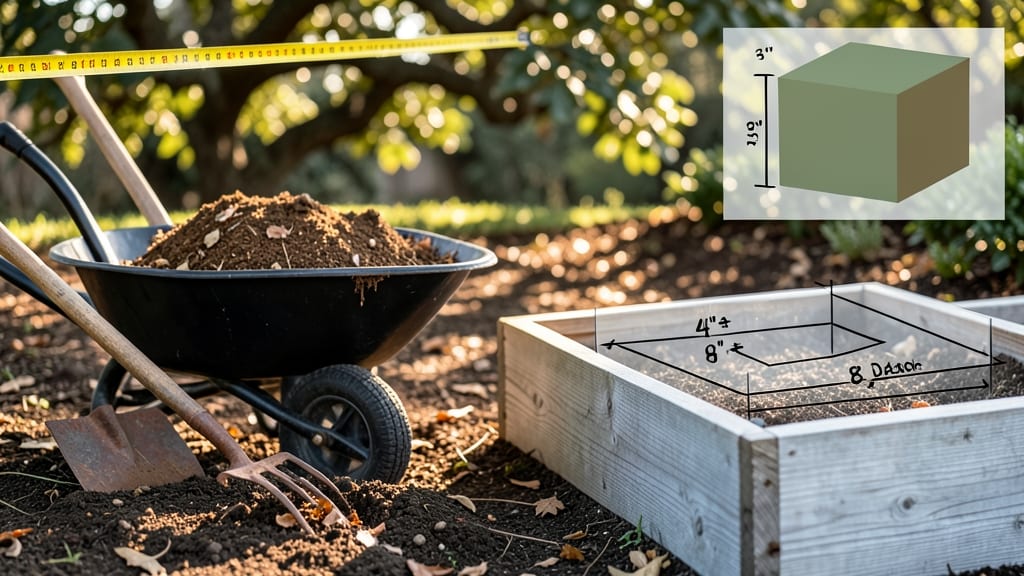
To determine how many yards of soil you need, multiply your raised bed’s length and width in feet, then divide by 324 to convert to cubic yards (e.g., a 4’x8’ bed needs ~1 cubic yard for 6” depth). For square foot gardens, use 0.75 cubic yards per 4’x8’ frame (6” depth). Adjust for deeper beds or bulk discounts.
Calculating the right amount of soil prevents waste and ensures your garden thrives. 🌱 For example, a 4’x8’ raised bed filled to 12 inches depth requires about 1.33 cubic yards—not the 1 cubic yard estimate—because soil settles over time.
I always recommend buying 10-15% extra to account for compaction and future amendments like compost. If you're unsure about soil quality, consider mixing topsoil with a bagged garden blend for better drainage and fertility.
For square foot gardens, the 0.75 cubic yards rule assumes a standard 6-inch depth, but deeper planting (like for root vegetables) may require up to 2 cubic yards for the same footprint. Bulk purchases often offer discounts, but store soil in a dry, shaded area to prevent clumping.
A simple moisture test—squeeze a handful—can tell you if the soil is ready for planting or needs more water before use.
💡 In This Article
- Calculating Soil Volume for Raised Beds and Garden Boxes
- Buying Soil in Bulk: What to Look for in Quality and Quantity
Calculating soil volume for raised beds and garden boxes
Let's break down the math behind soil volume calculations to avoid surprises at the garden center. The key is understanding how cubic yards translate from your garden's dimensions. Start by measuring your bed's length and width in feet, then multiply these numbers to get square footage.
For example, a 4-foot by 8-foot bed equals 32 square feet. To convert this to cubic yards for a 6-inch depth, divide 32 by 324 (the number of square feet in a cubic yard)—this gives you about 0.1 cubic yards, but that's just for 6 inches.
For 12 inches, you'd double that to 0.2 cubic yards per foot of depth. 🌱
Here's where most people trip up: soil settles over time. A freshly filled 12-inch bed might measure 14 inches after settling, reducing usable space. That's why I recommend adding 10-15% extra to your calculations. For our 4x8 bed at 12 inches, that means ordering 1.33 cubic yards instead of 1.
The formula becomes: (length × width × depth in feet) ÷ 27 = cubic yards, then multiply by 1.15 for safety. For deeper beds (like 18 inches), you'll need 2 cubic yards for the same footprint.
Square foot gardens follow similar principles but with smaller increments. Each 1-foot square at 6 inches depth needs about 0.03 cubic yards—so a 4x8 frame (32 squares) requires 0.96 cubic yards. Round up to 1 cubic yard to account for settling and future top-ups.
The difference between topsoil and garden mix matters too: topsoil compacts more, while pre-mixed garden soil retains structure better. I've found that mixing 60% topsoil with 40% compost gives the best balance of fertility and drainage for most vegetables.
Don't forget about the edges! Raised beds with thick walls (like cedar) take up space that's not usable for plants. Subtract 2-4 inches from each dimension before calculating if your bed has 6-inch+ walls.
For example, a 4x8 bed with 6-inch walls has a planting area of 3x7 feet, reducing your soil needs by about 15%. This edge adjustment is especially critical for circular or irregularly shaped beds where perimeter space is significant relative to the planting area. 🔥
For precise planning, consider using a soil depth calculator or spreadsheet. I've created one that accounts for:
- Bed dimensions: Length, width, and wall thickness
- Depth: Planting depth (6", 12", 18")
- Soil type: Topsoil vs garden mix compaction factors
- Amendments: Compost or peat moss percentages
Pro tip: When measuring depth, use a level to ensure consistent soil distribution. Uneven layers can create drainage issues or root stress. For beds deeper than 12 inches, consider layering: 6 inches of topsoil mixed with compost on top of 6 inches of heavier garden soil.
This mimics natural soil profiles and prevents compaction at the bottom. The texture difference—fine particles at the top, coarser below—helps water penetrate efficiently while keeping nutrients where roots need them most. ✨
Remember that soil volume calculations are just the starting point. The actual amount you need may vary based on your local soil's moisture content and how tightly it's packed.
Always do a "squeeze test" when you receive your soil: if it holds its shape when pressed, it's too dry and will compact further once watered. In that case, add 5-10% more to your order.
This attention to detail makes all the difference between a thriving garden and one that struggles with poor drainage or nutrient deficiencies.