
Vegetables
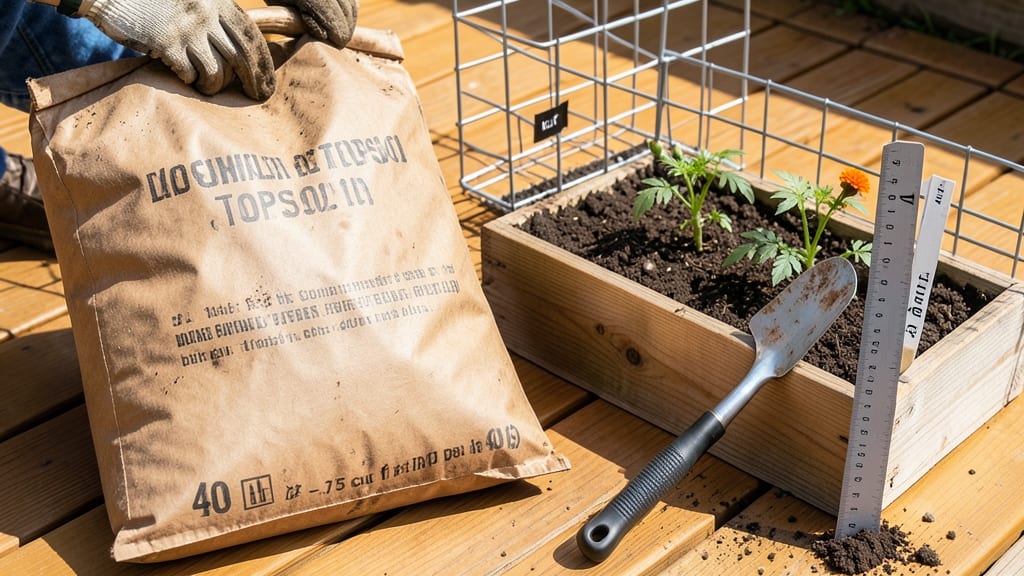
A 40 lb bag of topsoil converts to roughly 0.5 to 0.6 cubic feet, but this measurement shifts dramatically based on how compacted or moist the soil is. Dry, loose topsoil expands to nearly double the volume compared to wet or tightly packed soil.
A 40 lb bag of topsoil's actual volume depends heavily on its moisture levels and organic composition.
For example, sandy loam (common in garden centers) typically yields about 0.55 cubic feet per bag, while heavier clay-based soils may only reach 0.45 cubic feet due to higher density. 🌱 The key difference comes from how much air space exists between soil particles—dry soil holds more air pockets, increasing volume, while moisture fills those gaps, reducing cubic feet.
This variation is why gardeners should always check product labels for "loose cubic feet" measurements rather than relying solely on weight.
Understanding this conversion helps when planning projects like raised beds. A 10-foot-by-2-foot raised bed (20 square feet) with 6 inches of soil depth requires about 10 cubic feet of topsoil.
If using 40 lb bags with 0.5 cubic feet each, you'd need roughly 20 bags—but if your soil is compacted, you might need 25 bags to achieve the same depth. Always account for a 10% buffer for settling after watering.
💡 In This Article
- How Topsoil Weight Affects Cubic Foot Volume
- Calculating Topsoil Needs for Garden Projects
How topsoil weight affects cubic foot volume
The relationship between weight and volume in topsoil hinges on its bulk density, which measures how much mass occupies a given space. For a 40 lb bag, the typical 0.5-0.6 cubic feet range comes from standard garden topsoil (usually 60-70% mineral content with 10-30% organic matter).
Sandy soils have larger particles with more air gaps, giving them a bulk density of about 60-80 lbs per cubic foot, while clay soils pack tighter at 100-120 lbs per cubic foot.
This explains why sandy topsoil often measures closer to 0.65 cubic feet per 40 lb bag, while clay-based mixes may only reach 0.45 cubic feet.
Moisture content plays a dramatic role—dry topsoil can swell up to 20% more volume than wet soil because water fills the air pockets between particles.
Imagine scooping dry sand versus damp sand: the dry version holds its shape better and takes up more space. 🌱 For example, a bag labeled as containing 0.55 cubic feet when dry might shrink to just 0.45 cubic feet if saturated with water.
This is why professional gardeners recommend storing topsoil under cover and using it within 2-3 weeks to avoid moisture-related volume loss.
The organic matter percentage also shifts the equation. Topsoil with higher compost content (like 30%+ organic material) has more porous structure, increasing volume per pound. Think of it like comparing a sponge to a brick—the sponge (organic-rich soil) holds more air and expands further.
Conversely, mineral-heavy topsoil behaves more like gravel, with less expansion. This is why bags labeled "premium topsoil" often advertise slightly higher cubic feet per pound than basic garden mixes.
Compaction is another critical factor. When soil is packed tightly—whether by machinery during bagging or by your shovel during installation—it loses 15-30% of its loose volume.
For instance, a freshly opened 40 lb bag might measure 0.6 cubic feet when loose, but after being shoveled into a wheelbarrow, it could compress to just 0.45 cubic feet. This is why landscapers often recommend over-ordering by 10-15% to account for settling and compaction during projects.
To visualize these variations, consider this comparison:
- Dry, sandy topsoil: 0.6-0.65 cubic feet per 40 lb bag (low density, high air space)
- Moist, clay-based topsoil: 0.45-0.5 cubic feet per 40 lb bag (high density, minimal air space)
- Organic-rich topsoil: 0.55-0.6 cubic feet per 40 lb bag (balanced porosity)
For precise calculations, multiply the bag's cubic feet by the number of bags and compare against your project's total cubic feet requirement. For example, a 4-foot-by-8-foot raised bed filled to 12 inches deep needs 32 cubic feet of topsoil.
If using 0.5 cubic feet per bag, you'd need 64 bags, but if the soil is compacted, you might require 75 bags to achieve the same depth. Always measure twice and order accordingly!