
Landscaping
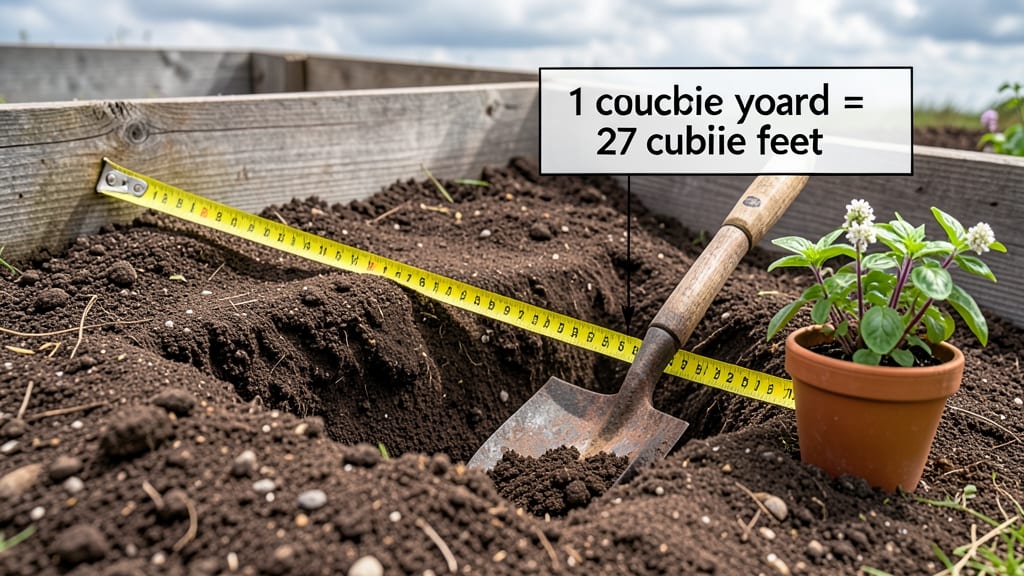
Converting 1 yard of soil to cubic feet equals 27 cubic feet, a standard measurement used in landscaping and gardening for calculating fill volume, raised beds, or planting areas.
Understanding this conversion is key because soil volume calculations directly impact project costs and material needs. A cubic yard measures 3 feet × 3 feet × 3 feet, but real-world soil density varies—loose fill compresses differently than bagged soil.
For example, a 2 cubic foot bag of topsoil actually provides less usable volume than the same weight in loose form due to natural settling. This math becomes especially important when ordering bulk materials, as landscapers often sell by cubic yards while retail bags are measured in cubic feet.
In practice, this conversion helps avoid overbuying or running short. Need 5 cubic yards of soil for a garden bed? That's 135 cubic feet—enough to fill a 5-foot × 5-foot × 5-foot space.
For slopes or uneven terrain, multiply the area's square footage by the desired depth (in feet) to get your cubic feet requirement, then divide by 27 to convert to cubic yards. Always account for 10-15% extra for compaction and waste.
💡 In This Article
- Understanding Soil Volume Math for Landscaping Projects
- Practical Applications for Measuring Soil in Cubic Feet
Understanding soil volume math for landscaping projects
The conversion from cubic yards to cubic feet comes from basic geometry: 1 yard equals 3 feet, so 1 cubic yard is 3 feet × 3 feet × 3 feet.
When you multiply these dimensions, you get 27 cubic feet—this is the foundational math behind all soil volume calculations. The key here is that soil isn't like water; it doesn't flow perfectly into containers. Instead, it settles and compacts differently based on moisture content, organic matter, and particle size.
For example, sandy loam (common in gardens) typically weighs about 100-120 pounds per cubic foot when loose, but when compacted, it can reach 130-150 pounds per cubic foot. 🌱
This variation explains why bulk soil sold by the cubic yard differs from pre-bagged soil measured in cubic feet. A 2 cubic foot bag of topsoil might contain only 1.5 cubic feet of usable material after accounting for bag thickness and settling.
Conversely, loose fill from a bulk order compresses more over time, potentially reducing your effective volume by 10-20% after installation. For precise projects like vegetable gardens, where root space matters, this difference can mean the difference between thriving plants and stunted growth.
Understanding this conversion also helps you avoid common pitfalls. For instance, if you're filling a 4-foot × 6-foot × 1-foot-deep raised bed, you'd calculate 24 cubic feet of soil needed.
Dividing by 27 gives you 0.89 cubic yards, but rounding up to 1 cubic yard ensures you have enough—especially if the soil settles or you need to account for drainage layers. Always measure your space in feet first, then convert to yards for ordering. 📏
Density variations become critical when working with different soil types. Clay soils, for example, can swell when wet and shrink when dry, affecting volume calculations. Meanwhile, peat moss or composted materials lose volume as they decompose.
For projects requiring precise measurements—like hydroponic setups or erosion control mats—you might need to adjust your order by 20-30% to account for these changes. Always check the moisture content of delivered soil; wetter soil weighs more but occupies less volume after drying.
Another practical consideration is how soil settles over time. A freshly filled garden bed might appear full, but after a few weeks of watering and foot traffic, the volume can decrease by 5-15%. This is why professionals recommend adding 10-15% extra material to your calculations.
For example, if your project requires 10 cubic yards, order 11-11.5 cubic yards to compensate for settling. This buffer ensures you won't run short mid-project, especially in large-scale landscaping where reordering is costly. 🏗️
For DIY gardeners, this math translates directly to cost savings. Buying soil in bulk (cubic yards) is often cheaper per cubic foot than purchasing smaller bags. For instance, a 1 cubic yard bag might cost $20, while 27 individual 2-cubic-foot bags could total $70 or more.
By mastering these conversions, you can plan purchases more efficiently and reduce waste. Always verify the soil's moisture content before ordering—dry soil takes up more volume than moist soil, which can lead to unexpected shortages.